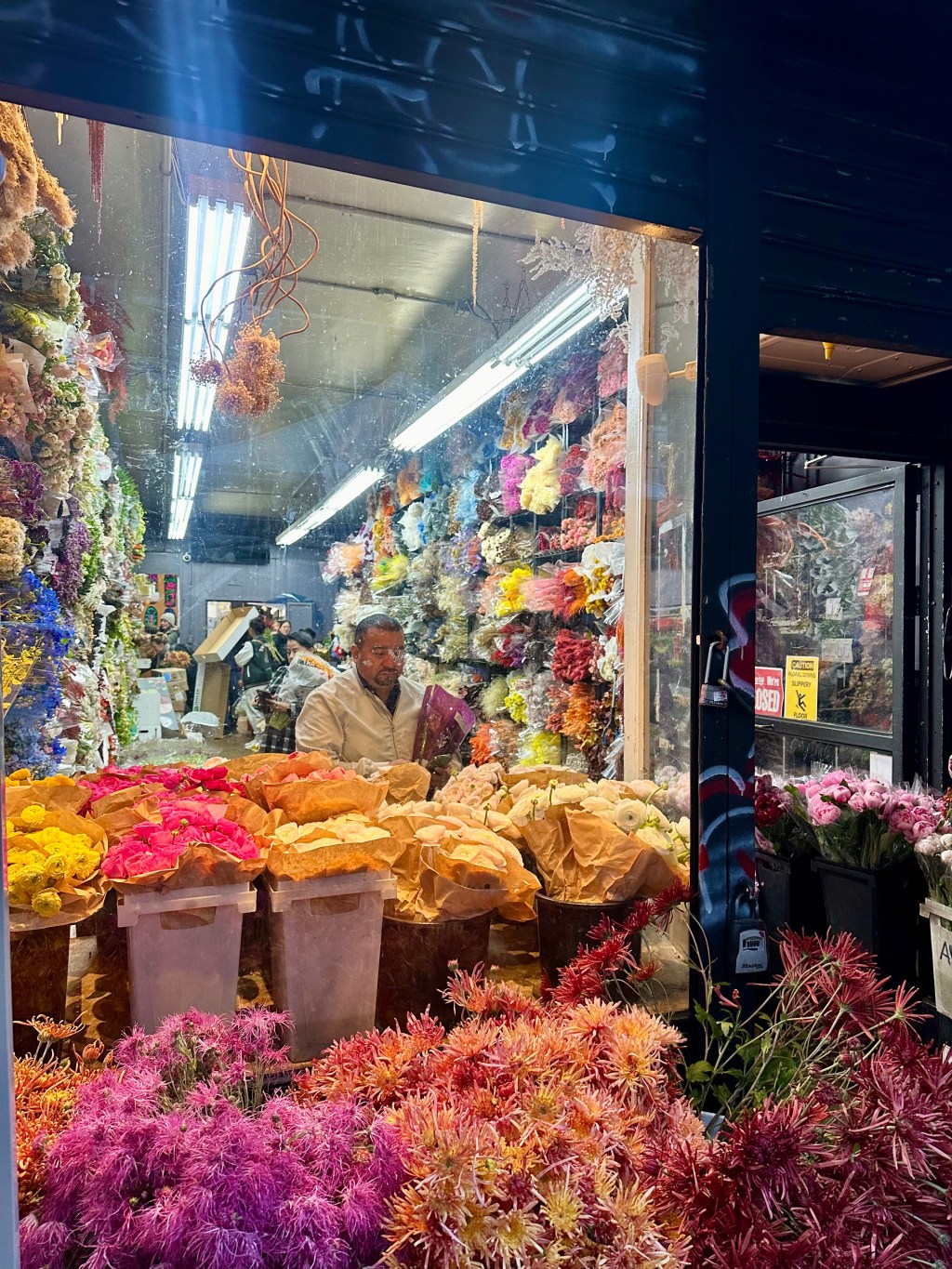
Thousands of COVID deaths kept business booming at Merry Flowers in Washington Heights throughout the pandemic. Grieving families ordered funeral wreaths and casket sprays. The store is located just a few blocks from New York Presbyterian Hospital; the foot traffic from people going in and out of the hospital was significant. Jesus Burgos, the owner, spent hours artfully arranging roses, carnations and lilies. Burgos and his employees came to work despite the virus raging outside. While furloughs and wedding cancellations halted business at other florists, Merry Flowers stayed open.
But once the virus abated, the store ran into trouble. “Everything changed after the pandemic,” Burgos said. A new landlord purchased 3801 Broadway, where Merry Flowers has its storefront, in 2022. They raised Burgos’s rent from $5,000 to $9,000. The supply chain disruptions that had developed during COVID continued, raising his costs. And people became less interested in flowers.
Burgos has worked in the flower industry his entire life. Before opening his own shop he worked at Olympia Florist at 3799 Broadway, just a few feet from Merry Flowers. But Olympia Florist fell on hard times and closed. It is now a GNC. Not long after, Burgos opened Merry Flowers in a small storefront next door.
While the florist’s neighbors have either closed or changed hands, Merry Flowers has withstood major changes in the community over the past ten years. Its signature red awning is visible from blocks away. Large white letters announce: “Merry Flowers.” Then: “flowers for all occasion, silk flowers, arrangement, party supplies, gifts, plant.” Below the awning stand buckets of roses, eucalyptus and orchids on makeshift, wooden shelves.
A black and white cat welcomes each customer at the door. Shelves line the walls on either side supporting a variety of colorful pots, plants and orchids. Ceramic elephants hold stalks of bamboo. In buckets on the floor, pre-made flower bundles are sold for $5.99. Behind the counter, teddy bears and stuffed animals sit on a shelf waiting to accompany a bouquet of flowers and a heartfelt note. In the back, a glass refrigerator preserves an array of flowers. Burgos takes orders over the phone while he trims thorns and stems. The floor is covered with discarded plant parts. His wife sweeps them up. He wraps each custom bouquet in brown kraft paper.
Like many other New York City florists, Merry Flowers buys flowers from Hunts Point Flower Market in the Bronx. Other flowers come from warehouses in Miami that import them from Holland, Colombia and Ecuador. Merry Flowers receives deliveries of flowers every week on Monday, Wednesday and Friday. Lilies, hydrangeas and roses are the most popular. Peonies and orchids are the most expensive. Burgos said that the average cost of each flower has risen from about three dollars to five dollars recently.
Most orders come from the nearby hospital and other local businesses, but people order from downtown as well. “We are one of the only flower shops around here that go the lengths of traveling downtown,” Bryana Paulino, a 22-year-old college student who works at the shop, said. Ordering from Merry Flowers is often cheaper than shopping in the floral district on 28th Street.
But, traveling downtown everyday eats up valuable time. Burgos used to employ a delivery driver, but had to let him go during COVID, and does not have the money now to rehire him. With the rising price of rent and other expenses, Burgos is unsure how long he’s going to be able to stay open. Soon, Merry Flowers may be replaced by a corporate storefront, just like Olympia Flowers was.
+++
People began to develop a passion for gardening and flower design during the Renaissance. Throughout Europe, people began to appreciate flowers for their natural beauty and scent. They planted gardens and cut flowers to arrange in conical shapes. Each flower developed a unique symbolism. Roses became an emblem of romance during the Renaissance and continue to repair relationships over 700 years later. The heart of the nascent flower industry was in Persia, which produced a number of different flowers for export.
In 1593, a doctor and botanist named Carolus Clusius arrived in Holland with a wildflower native to Turkey and Persia. It grew from a bulb in the ground and culminated in a blooming cup-shaped flower at the tip of a sturdy, green stem. The flower came in pink, red and yellow. It was a tulip and the Dutch quickly became obsessed.
Tulips were lucrative products with the opportunity to sell the flowers as well as the bulbs. At the time, the novel flower became a symbol of luxury in the gardens of wealthy Dutch families. French fashion had women wearing tulips like one would wear a jewel. In 1634, a craze called tulip mania overcame Holland. The price of one bulb exponentially increased to match the price of a Dutch canal house.
Just three years later, the tulip bubble popped. Tulips became worth less than five percent of their previous value. Despite the market’s collapse, Holland continued to dominate the industry and expanded to produce other flowers. Much of Holland is located close to sea-level and lacks enough land to support flower farms. To combat this, lakes and canals were drained. Today, according to Amy Stewart’s book Flower Confidential, tulip fields occupy 50,000 acres of land and another 20,000 acres are devoted to cut flowers. The Dutch industry brings in billions of dollars annually.
By 1880, the Dutch had technology to support an ever-changing market. They had figured out how to make flowers bloom before the spring season. They had constructed greenhouses specifically for roses and lilacs. Small markets and auctions sprung up in areas where flower farms were concentrated. The Dutch had to adapt again when cut flower production moved to the United States, Latin America and Africa in search of lower costs and better climate. Holland remains the top exporter of tulips but to compete Holland also exports knowledge in the form of breeding programs and greenhouse technology. Travelers at Schiphol Airport are greeted with an abundance of tulip bulbs to take home as souvenirs.
Meanwhile, the United States took advantage of the booming market supplying flowers to the entire country with farms concentrated in California. American growers advanced the industry by developing methods to ship flowers quickly. American greenhouses converted to oil or natural gas instead of coal. But again, the industry changed. Increasing prices of land and utilities made it difficult to sustain flower farming in California. American businessmen looked to Colombia for ideal weather, lower costs of labor, and fewer regulations.
In 1969, three businessmen founded a company called Floramerica whose goal was to grow flowers in Colombia and export them to the United States. Within six months flowers were loaded onto planes and shipped to the United States. Floramerica became outrageously profitable and was purchased by Dole in 1998. The innovative business model was adopted by hundreds of other companies.
Holland remains the dominant exporter of cut flowers. Colombia is second but Ecuador follows closely behind. Colombia produces a diverse array of flowers while three quarters of Ecuador’s exported flowers are roses. Most cut flowers come to the United States and the rest end up in Europe or Russia.
The floral industry was hit hard during the COVID pandemic. With no one celebrating events and employees furloughed, thousands of flowers died without being sold. Growers changed the type of flowers they grew and grew less of them. They started to focus on grocery stores rather than weddings and high-end events. Fewer air-conditioned trucks and planes held up delivery times. As a result, many wholesalers went out of business and the supply chain has not fully recovered. On top of that, a potential change in overall customer tastes could mean that the flower industry, overall, is heading for trouble.
+++
If you want to get a sense of who the flower market’s biggest players are, you need to head far uptown. In an industrial part of the Bronx populated by semi-trucks and warehouses, Hunts Point Flower Market dominates the wholesale industry. From the outside, it looks like a vacant garage but on the other side of the metal door is a massive depot. Long, rectangular cardboard boxes lie on tables displaying flowers from all over the world. Tulips from Holland. Monstera leaves from Costa Rica. Orchids from Israel. Roses from Ecuador. They sell dye and sparkles specifically for decorating flowers and plants. Two oversized walk-in refrigerators cool hundreds of fresh roses.
Frankie Rodriquez and his wife, Nelcida, have owned and operated the flower market since 2004. Before opening the market, Frankie worked at Harry Vlachos, a florist in Manhattan’s Floral District, for 18 years. Harry Vlachos has since closed. Now, Frankie supplies flowers to over 200 local florists in New York City, Westchester and Long Island, including Jerome Flowers, Jasmine Flowers, Floral Expression of Harlem, Barbara Flower Shops, Tango Flowers and, of course, Merry Flowers.
Business slowed significantly during the pandemic when events were canceled and it became difficult to import flowers. Still, Frankie came to work. The price of flowers increased dramatically and it took a year and a half to go back to normal, Frankie said. But Nelcida says it never did.“My understanding is that the price now is higher than it was before,” she said. Today, their struggle is the price of rent. When they started their business in 2004, rent was only $3,000. After the pandemic, it more than doubled.
On the opposite side of town, the Floral District is struggling with the same issue: rising rent. On a recent early morning in mid-November, the District was bathed in a golden hue as the sun came up behind the office buildings in the Flatiron District. All along the street, people were transporting plants and buying cut flowers. Tall white trucks lined both sides of the street leaving barely enough room for cars to pass. People stood outside in jackets taking inventory and pulling out long, rectangular boxes and placing them on the concrete. Shelves on wheels rolled potted plants and buckets of flowers out of shops and onto the sidewalk where they were arranged in displays. A man power-washed the sidewalk, clearing dirt and leaves from in front of his store. The Floral District opens early—5:30am, for most stores, so they can make their morning deliveries to hotels, funeral homes, and other event spaces throughout the city—and they close early, too: by 11am, the District is mostly deserted, the business of the day complete.
The emphasis in this most sensuous of blocks is not on beauty. The stores look like garages, but they offer every flower you could imagine. Buckets of fresh flowers are organized in rows on the floor. Carnations, lilies, tulips, roses. They weren’t trendy or aesthetically pleasing. They were reminiscent of a Home Depot—but for fresh flowers straight from the best distributors in Miami, as well as Hunts Point.
Jesus Segura, a designer at Flowers on Essex, told me that most flower shops start arranging their displays and organizing rows of fresh flowers at 3am. Flowers on Essex opens a little later. A neon sign flashes in the window: Roses, Roses, Roses. The shop is narrow and carpeted with artificial grass. Plastic buckets filled with water and roses sit on either side of the room. Bunches are held together by cardboard protecting the buds. The recycled cardboard reads Rosa Nova, a grower located in Ecuador. Segura sits on a stool in the back. He’s at a wooden table with white roses laying in front of him.
“28th Street is a rough street to get a good start,” Segura said. He’s been working in the Floral District for 30 years. He’s seen many businesses come and go. He said some business owners have been pushed out because of rising rent. He’s also seen a new generation come in—often inheriting stores from their parents—that cares less about fresh cut flowers. Some of them, he said, have started selling potted plants.
He peels off the dirty rose petals and drops them to the floor beneath him. He cuts the stems short to fit the shallow square vases. He wraps eighteen roses together with two thin green wires and places them in a vase. He repeats these steps over and over. He is making bouquets for nearby hotels. He supplies them with fresh flowers weekly.
“If we don’t have hotels, we’d be out of business,” he said. In the years after the pandemic, Flowers on Essex has had to shift their business model to survive. The florist used to cater to weddings, funerals and everyday occasions. Now, they focus on wholesale, selling a large amount of flowers to smaller florists, as well as to hotels.
Not all flowers are created equal. There are numerous differences between florist flowers and supermarket flowers that divide the industry. The main distinction is quality and freshness. Florists spend valuable resources ensuring that their flowers come from reputable growers and in keeping them in optimal conditions. Supermarket flowers are mass-produced and have a shorter life-span. Another difference is the variety of flowers. Grocery stores often have a limited array of popular flowers like roses. They often cannot offer customized bouquets. Florists can offer a wide variety of exotic and rare flowers which is ideal for weddings and other special occasions. The most obvious difference to customers is the price. Supermarkets buy flowers in bulk and can pass discounts on to customers. Florists have considerable overhead that makes it difficult to compete with grocery stores.
+++
Mark P. Bridgen, a professor of Horticulture at Cornell University, has watched the flower industry decline for years. He says that the pandemic was the final “nail in the coffin” for many businesses. The obvious reasons include complications with the supply chain and inflation. It’s easier and more profitable for wholesalers to provide a large amount of low-quality flowers to supermarkets. In turn, supermarkets can undercut florists that sell expensive, high-quality flowers. Bridgen has experienced this himself. He advises a student group who holds a Valentine’s Day rose sale each year to raise money. “And it’s cheaper for them to buy roses and carnations from Wegmans than it is for them to buy from a wholesale supplier. Is that crazy? That’s crazy,” Bridgen said.
Bridgen says that florists are also suffering from the same affliction as most other retailers: the rise of the digital age. 1-800-FLOWERS, a flower delivery service, does the same thing for florists as UberEats does for restaurants. Customers order flowers online and 1-800-FLOWERS finds a local florist to package and deliver the order. But there’s a catch: Jesus Burgos of Merry Flowers says this company takes about 30% of the sale. He feels the company is taking advantage of him and other florists.
Bridgen also says that the shift to working from home has lowered foot traffic in retail stores. “That’s why they keep talking about trying to convince people not to work from home,” he said. “It’s all those little retailers, the restaurants and coffee shops and all those places that don’t have the foot traffic that normally stop in and impulse buy.” When people work from home they don’t pass by a bodega and spontaneously purchase flowers to bring home to a loved one. This is true for office districts like Midtown and the Financial District, but it’s also true for Washington Heights. A New York Times article from 2016 celebrated the neighborhood for its friendliness and affordability. It pointed out several businesses in the area that the author enjoyed visiting. Of the five businesses mentioned, two were no longer around by 2023. Only Columbia Wine Company, Carrot Top and Merry Flowers remained.
Another trend plaguing the floral industry is an overall decline in consumer interest. Bridgen says recent studies show that customers think cut flowers are expensive and want something that has a longer life. “If they have a choice between buying a potted philodendron that will last them for, you know, maybe forever but at least for five years, compared to a dozen roses, they’re going to go with a potted plant and put a bow on it and make it look attractive,” Bridgen said.
Not only are potted plants more affordable for consumers but they’re also more affordable for growers and retailers. Many plants can be grown in warm parts of the United States like Georgia, South Carolina, Florida and Texas. This decreases prices for growers who don’t have to pay for heating and retailers who don’t have to pay international shipping costs. When I asked Bridgen if a succulent could ever replace a beautiful gift like a bouquet of roses, he said, “I think people nowadays consider a potted plant as a gift as romantic as cut flowers.” And this is a problem for someone like Jesus Burgos.
+++
Burgos has kept Merry Flowers alive through the industry’s dramatic changes. But now, he is forced to consider closing. “We’re trying to survive,” Burgos said. I visited Merry Flowers numerous times over the last few months. Burgos was often packaging orders and rushing out the door to deliver them. I wanted to talk to customers, but there weren’t many.
The new building owners’ office is located on 23rd Street inside of a towering glass building. Burgos visited to try and negotiate the price of rent, but he failed. “You feel so small walking into a huge place like that,” Paulino said. They wouldn’t budge despite Burgos renting the building for ten years. “They don’t care,” he said.
Wholesalers across the city are forced to make difficult decisions. They stick around for the average customers who decorate their homes and relationships with delicate flowers. But, Jesus Burgos and florists like him might have to close their doors as numerous factors threaten profits. In the meantime, Jesus Segura says, “You should appreciate when someone brings you flowers.”




 Catherine McGrath
Leave a comment